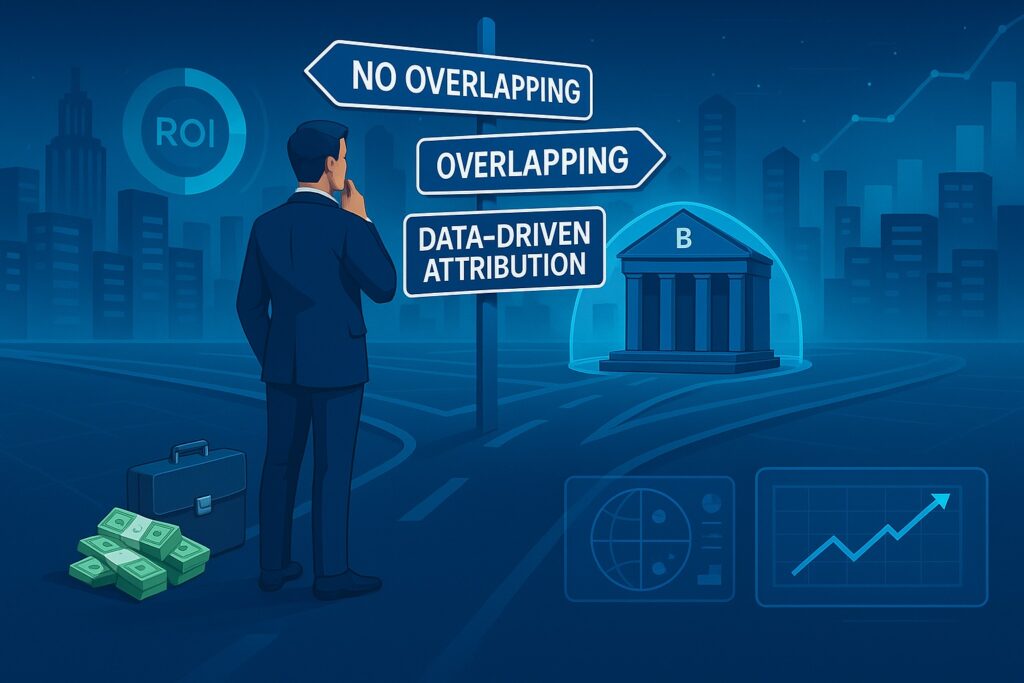
Understanding which marketing channels truly drive value has become a central challenge in data-driven decision-making. Attribution models — the methodologies used to assign credit for conversions — are pivotal in determining where marketing budgets go and how strategies evolve. But not all attribution models are created equal.
Below, we examine three major types: No Overlapping, Overlapping, and Data-Driven Attribution (DDA) — each offering distinct perspectives, advantages, and trade-offs.
No Overlapping Attribution
Examples: Last Click, Last Non-Direct
This model attributes 100% of the conversion credit to a single interaction — typically the last touchpoint before conversion.
Pros:
- Simplicity at its finest: Easy to implement and understand. A straightforward model that appeals to teams needing fast insights with minimal complexity.
- Highlights the ‘closers’: Final-stage channels such as email, direct traffic, or retargeting often receive the credit, aligning investment with those seen as sealing the deal.
Cons:
- Blindsided by beginnings: Early-stage touchpoints — awareness-building tactics like display ads or social media — are ignored, despite their critical role in sparking interest.
- Budget bias: This model risks channelling too much investment into ‘closers’ while starving early-stage efforts, skewing the strategy towards short-term wins.
Overlapping Attribution
Examples: Last click per channel group — Awareness (Display, Video), Intention (SEO, PPC), Sale (Email, SMS), Offline (Branch)
This approach attributes credit to the final touchpoint within each channel group, acknowledging multiple stages in the journey.
Pros:
- Group-based clarity: Still relatively simple, but smarter. It recognises the importance of distinct channel roles and helps balance budget allocation across the funnel.
- Limits over-crediting: Retention and sales channels (email, push, SMS) no longer steal all the limelight — a fairer view emerges.
Cons:
- Theory vs. reality: Built on assumptions about how users behave — which can vary wildly across industries and audiences. Different attribution windows add more complexity.
- Uncommon and underexplored: As it’s not standard practice, organisations must define models internally — often fueling debates over what belongs where and why.
Data-Driven Attribution (DDA)
A machine learning-based model that allocates credit based on the actual contribution of each touchpoint, using historical data.
Pros:
- Holistic and tailored: Offers a nuanced, data-backed view of how channels interact across the full journey — from discovery to decision.
- Smarter budget planning: DDA optimises allocation by showing which investments actually move the needle.
- Custom-fitted to your business: As it’s trained on your own data, it reflects the unique characteristics of your customers and campaigns.
Cons:
- Requires in-house capability: Building a reliable DDA model is not plug-and-play — it needs data infrastructure, analytical chops, and buy-in from leadership.
- Still relatively rare: Despite its advantages, DDA isn’t yet common practice outside more data-mature organisations.
How DDA Works
- Collect Conversion Data from all sources into a central repository (e.g. a data lake).
- Analyse Patterns in touchpoints and sequences using machine learning.
- Assign Credit Dynamically, updating based on behavioural trends.
- Continuously Improve, adapting to market shifts and evolving customer behaviour.
DDA in Action: A Practical Example
Let’s say a user’s journey looks like this:
- Clicks a Google PPC ad (Step 1)
- Receives a retargeting email (Step 2)
- Returns via SEO search and converts (Step 3)
A Last-Click model gives all the glory to SEO. But DDA sees the fuller picture:
- PPC Ad: 30% (sparked interest)
- Email: 40% (kept engagement alive)
- SEO: 30% (sealed the deal)
It even tracks non-click interactions, like an unopened email that influenced recall.
Final Thoughts
Choosing the right attribution model isn’t just a technical decision — it shapes how marketing is valued inside an organisation. No Overlapping models offer quick wins; Overlapping models add nuance; DDA delivers precision, but demands capability.
As banks and financial services step deeper into digital maturity, the case for smarter attribution grows. The better you understand the journey, the better you invest in the road ahead.