
In the realm of digital lending and performance marketing, companies are often awash with operational metrics — application rates, approval volumes, and disbursement counts. These are useful indicators, but they obscure the fundamental question that every lender should be asking: Which customers generate actual profit, and to what extent?
To answer that, one must look beyond surface-level data. Enter Net Present Value (NPV) modelling — a strategic tool that shifts the focus from raw activity to sustainable, risk-adjusted profitability.
What NPV Modelling Really Measures
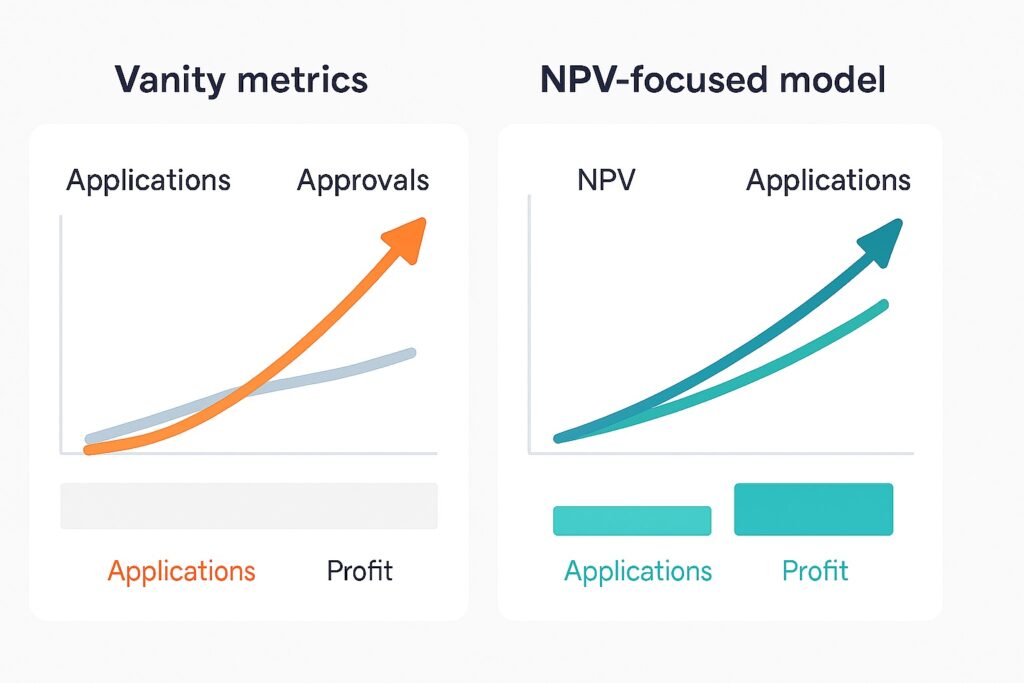
The NPV approach calculates the net economic value of a single disbursed loan by estimating the expected future cash flows and discounting them to the present. This includes a comprehensive accounting for:
- Cash flow timing and risk, adjusting for early repayments, defaults, and behavioural volatility.
- Customer acquisition costs encompass media, scoring systems, human support, and channel overhead.
- Risk segmentation, through models built on Probability of Default (PD), behavioural scoring, and cohort analytics.
- Capital cost of time, via discounting methods that reflect the opportunity cost of money.
Crucially, NPV doesn’t just ask “What happened?” but rather, “What was it worth?” It enables teams to challenge the illusion of growth and instead focus on economic contribution.
From Insight to Strategy

Where traditional dashboards reward volume, NPV provides clarity on value per unit. The model empowers companies to:
- Identify profitable and unprofitable marketing channels with surgical precision.
- Optimise customer acquisition strategies by targeting cohorts with the best risk-adjusted returns.
- Reallocate capital intelligently, avoiding false positives created by short-term metrics.
- Strengthen collaboration between marketing, credit risk, and finance by grounding conversations in shared profitability metrics.
It becomes not just a reporting tool, but a strategic lens.
Strategic Questions NPV Helps Resolve
NPV modelling helps answer the questions that matter most to decision-makers:
- Which acquisition channels generate sustainable returns, and which only appear effective?
- Are current CPAs (Cost Per Acquisition) economically viable once defaults and churn are accounted for?
- How has customer quality evolved over time, and what are the leading indicators of future deterioration?
- Can marketing budgets be scaled without eroding margin or increasing default rates?
- What is the true Lifetime Value (LTV) — net of acquisition, risk, and operational friction?
Perhaps most importantly, it provides a framework for evaluating the cost of action versus inaction, informing not just what is profitable, but when.
What We’ve Learned from Real-World Implementation
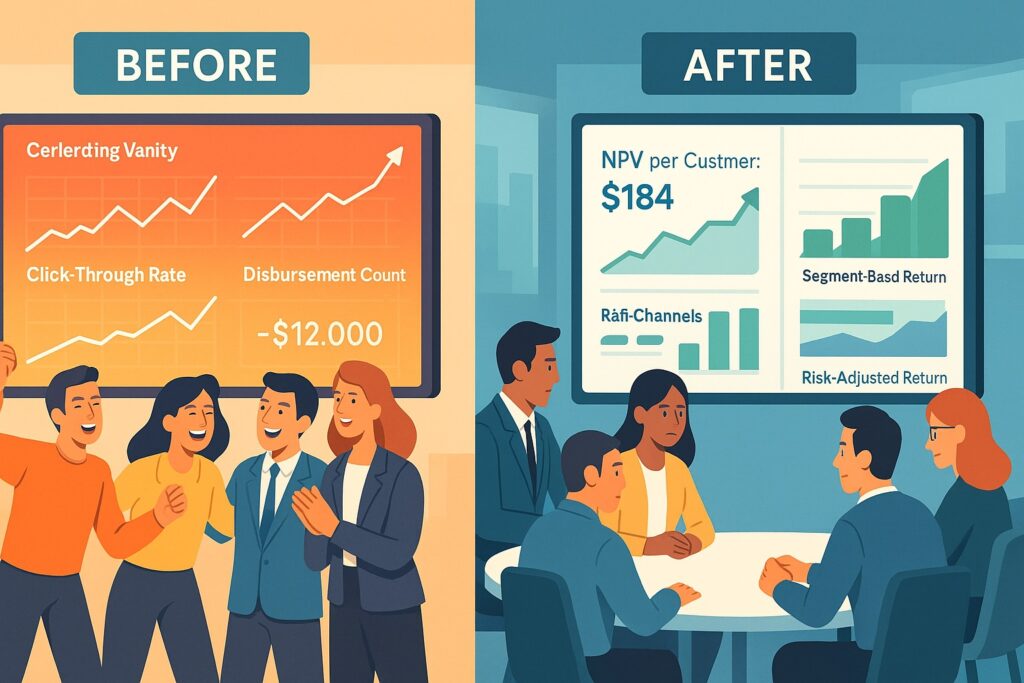
Across multiple fintech and digital lending businesses, NPV implementation has consistently surfaced uncomfortable truths, but also revealed hidden opportunities:
- Several “high-performing” acquisition channels were, in reality, value-destructive, generating negative NPV per loan.
- Between 20% and 30% in cost savings was identified, often without reducing disbursement volume.
- Behavioural segmentation and risk scoring, when applied to NPV tiers, enabled more precise targeting and reduced adverse selection.
- The ability to detect deteriorating trends in PD or take-up rates was significantly accelerated, shifting strategy from reactive to predictive.
The result is not just better BI — it is profit intelligence.
Why It Redefines How Growth Is Measured
Firms that embrace NPV stop scaling blindly and begin to allocate capital with intentionality. The model enables forecasting and experimentation:
- What happens to profitability if the attribution window is extended?
- Can risk be maintained if scoring criteria are relaxed?
- Is an increase in CPA justifiable if customer quality improves?
NPV creates a controlled environment to test strategic levers before committing budget. It aligns risk appetite with growth ambition — a rare but potent combination.
An Invitation to Strategic Partners
If you are building or scaling a lending operation — or leading performance marketing with a mandate to improve ROI — NPV modelling offers a disciplined, data-driven path forward.
Whether you need to construct a model from scratch or calibrate an existing framework, we help firms:
- Quantify profitability by customer, channel, and segment.
- Unite marketing, risk, and finance around shared value metrics.
- Transition from activity tracking to outcome-based growth.
To grow sustainably, first understand your true economics.
Let’s begin there.