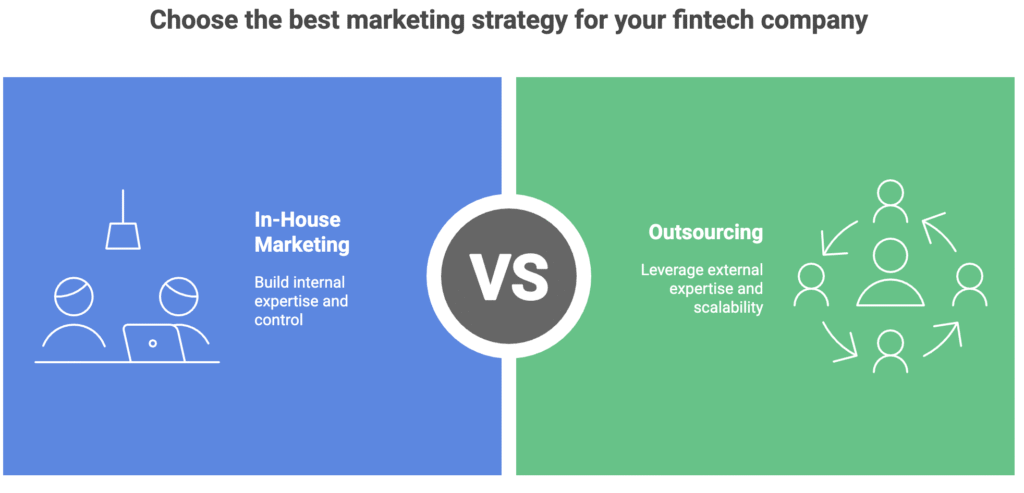
Let’s explore the strategic decision of when to hire in-house versus outsourcing for your fintech marketing strategy. Understanding the right approach at each stage of your company’s development is key to marketing scalability in fintech and long-term success.
Startup Phase – Outsourcing: Your Launchpad
When you’re just starting, your primary focus is to get your product or service out there quickly and efficiently. You’re likely operating with a limited budget and a lean team. This is a typical scenario in a startup marketing model. This is where an outsourced marketing agency for startups can be a game-changer. Agencies have the expertise and resources to develop your landing pages rapidly, set up your marketing campaigns, and generate initial traction. They can help you hit the ground running while you focus on building your core product and refining your business model. This phase is critical for establishing your fintech marketing strategy and accelerating brand visibility.
Growth Phase – Hybrid Model: Balancing Speed and Control
As your startup gains traction and enters a growth phase, you’ll need to balance the need for speed with the desire for greater control over your brand and customer experience. This is where a hybrid marketing team can be particularly effective. You can outsource certain marketing functions, such as social media management or content creation, while keeping in-house critical aspects like data analysis, risk management, and customer support. This hybrid approach is ideal for fintech growth marketing and provides a flexible framework for evolving teams. It allows you to leverage external expertise while maintaining oversight of key business areas.
Established Phase – In-House: Deepening Expertise and Alignment
Once your fintech company is established and you have a strong brand identity and company culture, bringing your marketing in-house is often beneficial. This allows you to build a team that deeply understands your product, customers, and the company’s values. It also enables you to develop long-term expertise and create marketing strategies perfectly aligned with your overall business goals. An internal team strengthens your fintech marketing strategy and supports agile marketing for fintech startups. In-house marketing teams can also be more agile in responding to market changes and customer feedback.
Feature Comparison: In-House vs Outsourcing
| Feature | In-House | Outsourcing | Bandera |
| Cost | Higher (salaries, benefits, office space, equipment) | Variable (project-based or retainer fees) | Variable (project-based or retainer fees) |
| Speed | Can be slower to hire and onboard | Faster to get started with an existing team | Faster to get started with an existing team |
| Control | Complete control over all aspects of marketing | Less control, dependent on the agency’s expertise and processes | Complete control over all aspects of marketing |
| Flexibility | Less flexible to scale up or down | More flexible to adjust resources based on needs | More flexible to adjust resources based on needs |
| Knowledge | Deep knowledge of the company culture and product | More surface-level knowledge, dependent on briefing and communication | Deep understanding of the company culture and product |
| Alignment | High alignment with company goals and values | Alignment can vary depending on the agency’s understanding of your business | High alignment with company goals and values |
| Long-Term Expertise | Builds long-term expertise within the company | Relies on external expertise, which can change over time | Transfer long-term knowledge to the company to build in-house expertise |
This comparison highlights the key considerations when evaluating internal vs external marketing teams.
Pros and Cons: In-House vs Outsourcing vs Bandera
In-House
- Pros: Full control, strong alignment with company culture, builds long-term expertise, fosters innovation, can be more agile in responding to market changes
- Cons: Expensive, less flexible, can be challenging to find and retain top talent, requires investment in infrastructure and training
Outsourcing
- Pros: It is a cost-effective marketing option for fintech companies, offers access to specialised skills and expertise, is scalable, allows you to focus on core competencies, and can be faster to get started.
- Cons: Less control, potential for communication challenges, reliance on external partners, can be less aligned with company culture, may require ongoing management and oversight.
Bandera
- Pros: Cost-effective, access to specialised skills and expertise, scalable, allows you to focus on core competencies, definitely faster to get started, and complete control, Educates the internal team
- Cons: Reliance on external partners can be less aligned with company culture and may require ongoing management and oversight.
The Future of Fintech Marketing: Hybrid Models and Product-Specific Teams
The fintech landscape is constantly evolving, and fintech marketing strategies must adapt accordingly. In the coming years, we can expect to see a rise in hybrid marketing teams combining the best of in-house and outsourced marketing. Companies will likely keep core marketing functions in-house while outsourcing specialised tasks or campaigns to agencies or freelancers. This flexible model enhances marketing scalability in fintech and allows teams to remain agile.
We can also anticipate the emergence of product-specific marketing teams dedicated to promoting and supporting individual products or services within a company’s portfolio.
Some cases
📍 TONIK Bank (Philippines) utilised Google Cloud and partnered with agencies for its launch. Post-Series A funding, they transitioned to building an in-house team.
🔗 Tonik Case Study | Google Cloud
📍 Revolut scaled globally by outsourcing marketing and support services.
🔗 Revolut Marketing Strategies
📍 Monzo expanded its internal data team from 1 to 30 members to handle growing demands.
🔗 Monzo’s Data Stack
📍 Due to the collaboration with Bandera Agency, TONIK increased paid channel sales volume by 2.3 times while reducing the cost of credit acquisition by 4.3 times, achieving exceptional efficiency and scalability without expanding the in-house team or requiring additional internal team development.
These fintech marketing case studies demonstrate the tangible benefits of each model depending on the growth phase and strategic goals.
Making the Right Decision for Your Fintech Startup
The decision of whether to build an in-house marketing team or outsource to an agency is not one-size-fits-all. It depends on various factors, including your company’s stage of development, budget, marketing goals, and internal resources. Evaluating your startup marketing model using real-world examples can provide greater clarity. By carefully weighing the pros and cons of each approach and considering your company’s specific needs, you can make an informed decision that will set your fintech growth marketing efforts up for success.
Drop us a message to learn more: